Where money is lost
When the provider deploys a cluster and starts allocating resources to customers, the next important stage begins.
Now it is necessary to monitor how these resources are used and correctly calculate their cost for billing. It is important to consider not just the fact of creating a virtual machine, but its actual consumption – CPU, memory, disk and network. All of this should be accurately recorded and turned into a clear bill for the customer.
First, the system collects data on how resources are used. Then it transfers this data to accounting, calculates the cost, and generates an invoice.
If this chain is not properly configured or if there is a gap in the process, the resource may already be in use by the customer, but it may not appear in the billing system until later. The more customers and the higher the load, the greater the discrepancy becomes.
At first, such losses are almost imperceptible, but they accumulate over time. As the infrastructure and the number of services grow, the difference between actual consumption and what is calculated becomes increasingly significant.
Additionally, this limits scalability. Each new service requires the entire accounting, billing, and tariffing chain to be updated. As a result, this begins to slow down development faster than external market factors.
Where time is lost
Most of the time is spent not on starting the infrastructure, but on linking it to the economic part. You need to set up resource accounting, link tariffs, connect billing and payment system, and then – the client interface.
Each element can be done separately, but together they turn into a complex chain of dependencies that gets heavier with each new service.
In practice, it looks like this: infrastructure is deployed quickly, and then for months “reduce” accounting and money. As a result, the launch of the cloud turns not into the launch of a service, but into the development of its own platform.
This directly affects time-to-revenue: until the entire chain is assembled, revenue does not begin, even if resources are already being used.
How to link resources, accounting, and billing
The cloud becomes truly manageable when accounting is built directly into the infrastructure. This is what the vStack SPP program is built on.
The vStack Service Provider Program (vStack SPP) is a licensing model for companies that provide cloud services.
Instead of a set of disparate systems, the provider gets a ready-made bundle: infrastructure and a way to monetize it. vStack HCP is responsible for virtualization and resource management, while vStack Cloud Panel combines service ordering, consumption accounting, and billing in one system.
This allows you to build private, public, and hybrid clouds and provide IaaS, PaaS, and SaaS services to your customers.
The program includes the following features:
- vStack Cloud Panel — a unified dashboard for managing services and users
- Pay-as-you-Go billing model
- vStack Exchange Hub as an additional sales channel
- vStack HCP virtualization platform
Billing is based on projects, so you can always see the actual resource consumption. Based on this consumption, billing automatically generates invoices using a tariff model.
Since 2019, vStack has been used by the cloud provider Falconcloud as one of its two main virtualization systems.
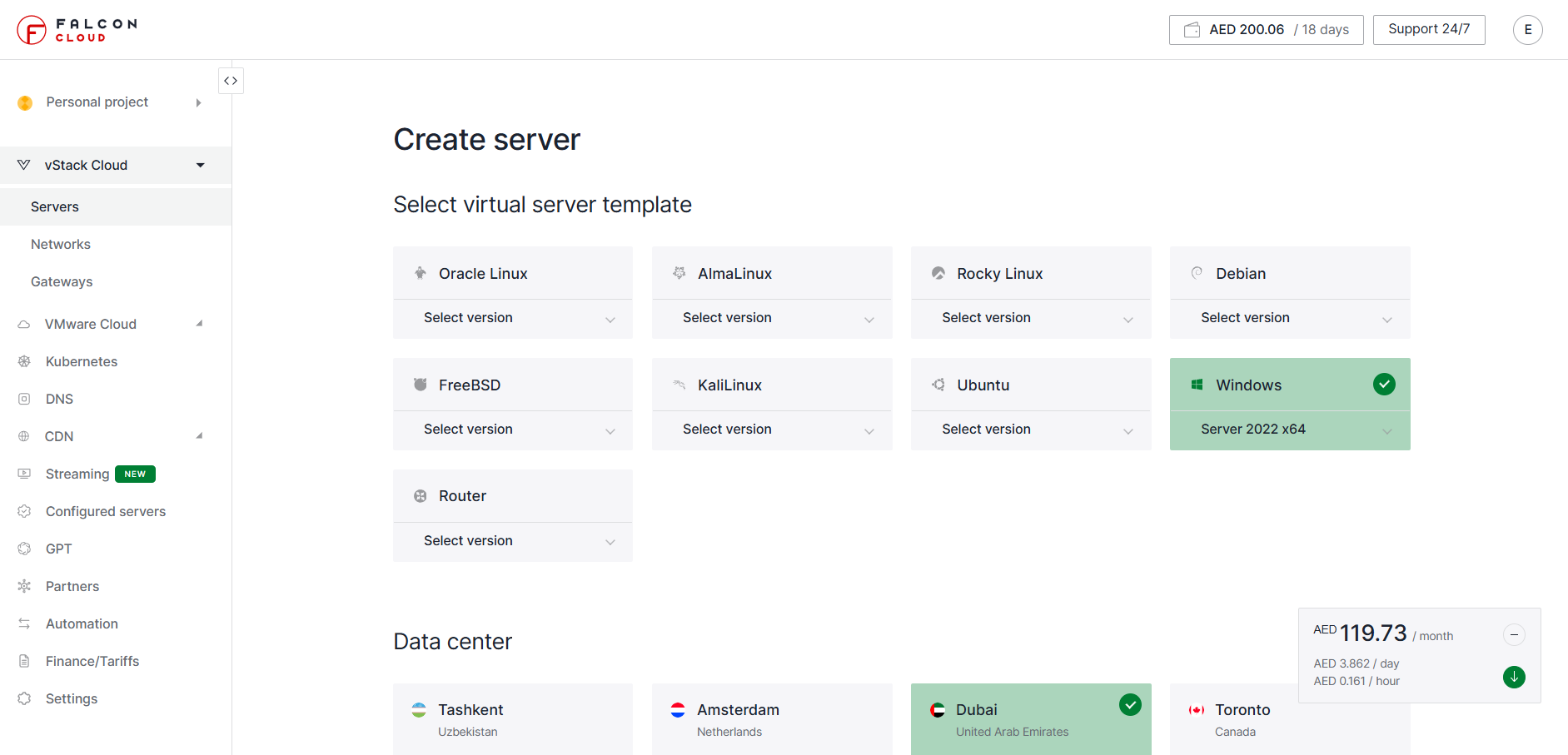
In addition to virtual machines, the panel also supports additional services such as S3, CDN, SSL, DNS, and VPN. It also allows you to manage external services, including Kubernetes and VMware vSphere.
The pay-as-you-go model of vStack SPP allows you to pay only for the resources you use, making it easier for the provider to start without high initial costs.
What to look at when launching a service
The cost of launching a cloud depends not only on the servers and the hypervisor, but also on how quickly the provider can link the infrastructure with accounting, billing, and tariffing.
If there is a gap between these elements, the launch is delayed, and the first revenues appear later. If everything works as a single system from the very beginning, the cloud starts functioning as a business right away.
The next step
When launching or upgrading a cloud service, it is important to look not only at the infrastructure, but also at how it is connected to accounting and billing.
It is this connection that determines how manageable, predictable, and quickly the system will be brought to market.
Learn more about the program for service providers and the terms of connection