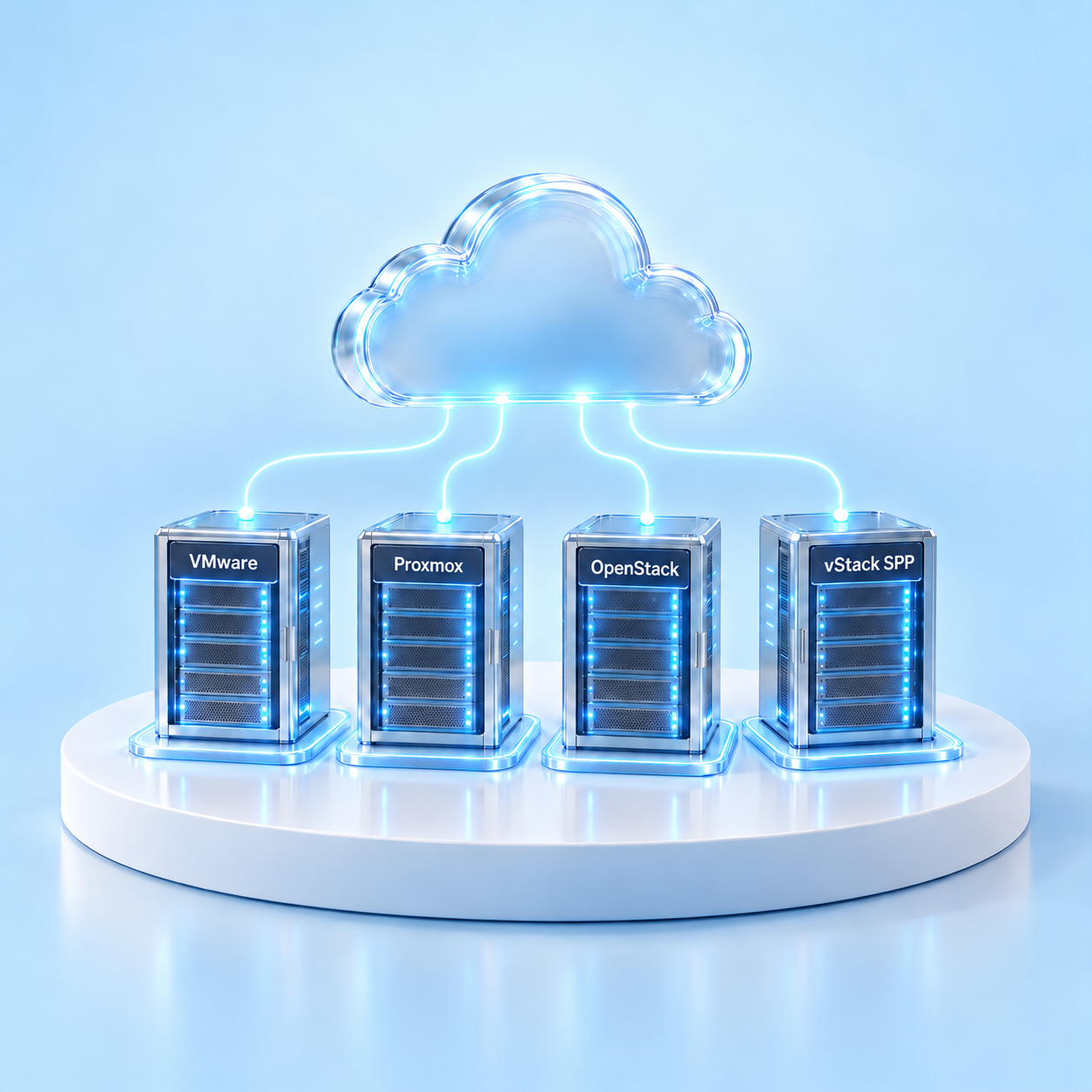
The cloud is gradually learning to manage itself. Not long ago, engineers manually configured servers, monitored schedules, and fixed failures. Now, part of this work is being taken over by artificial intelligence, and developers promise that soon the cloud will run almost without human intervention.
We’ve looked into which of these promises are already true and which are still just predictions.
AI in cloud management at a glance
AI is already good at identifying problems in the cloud and suggesting solutions. But the final say is still up to humans: AI can only perform simple and safe actions on its own.
In the article, we distinguish between two types of AI:
AI assistant:
Analyzes data and advises what to do. The decision is made by a person.
Today, this type is the majority.
AI agent:
Performs the action itself: restarts the service, changes the server capacity, rolls back an update.
So far, only simple tasks are trusted to it.
What AI can and can’t do in the cloud today
| Task | What AI can do today | What AI can’t do yet |
| Monitor system performance | Detect failures and unusual behavior | Fix the problems it detects on its own |
| Right-size server capacity | Identify where the company is overpaying | Adjust capacity independently without limits |
| Investigate incidents | Quickly identify the likely cause | Resolve complex incidents on its own |
| Control cloud spending | Flag overspending and forecast the bill | Decide independently where to cut costs |
| Handle routine team tasks | Review code, write tests, and send alerts | Define its own operating rules |
What AI can already do in cloud management
Cloud monitoring and anomaly detection
A large company has hundreds of servers and applications running. Previously, the on‑call engineer monitored dozens of graphs and looked for where something had gone wrong. Now, monitoring services – Datadog, Dynatrace, New Relic, Grafana – do this for them: they detect a spike in errors, suspicious traffic, or unusual load and immediately show where to look.
What’s not there yet: AI shows the problem but doesn’t fix it itself. But this is its most reliable role: if it makes a mistake, there will be no harm, it will just send an unnecessary notification.
Cloud optimization: it tells you where you’re overpaying.
Companies often rent servers with excess capacity and pay for power they don’t use. Cloud providers have built AI advisors for this purpose: AWS Compute Optimizer, Azure Advisor, Google Cloud Active Assist. They analyze how the servers have actually been used over the past few weeks and suggest simpler, cheaper options.
What’s still missing: a person applies the advice. There are services that change settings on their own, but only within the limits set in advance by the team. Their promises regarding savings are still hard to verify: the figures are usually published by the sellers themselves.
Cloud incident detection and troubleshooting
When a website doesn’t load or payments fail, time is of the essence. Services like PagerDuty and incident.io collect all warning signals in one place and suggest what’s most likely broken. Then you can trigger pre‑prepared actions: restart the service or roll back to a previous version.
What’s not yet available: a serious AI failure won’t fix itself. Without a human, it can only handle simple cases where a mistake won’t break anything.
Cloud cost monitoring and overspending alerts
The cloud bill often turns out to be higher than expected. AWS Cost Anomaly Detection, Microsoft Cost Management, and Google Cloud Billing services compare daily spending with regular patterns, alert if something stands out, and forecast the amount at the end of the month. The reason for overspending is usually simple: a forgotten test server, a surge in visitors, or an error in the settings.
What’s not yet available: AI isn’t trusted to decide what to cut back on. This is still the responsibility of the budget holder.
DevOps automation and routine tasks
AI checks the code, writes tests, and helps newcomers understand the project. Automation services connect systems to each other: for example, in case of an error, they automatically create a task and send a notification to the messenger.
What’s not yet available: people write the rules for such automation. In the future, AI will start proposing them on its own, and the engineer will only need to approve them.
The future of AI and cloud automation
No company currently has a fully self‑managing cloud. In all the examples above, AI works under human supervision. But analysts expect this to change quickly. Here is Gartner’s forecast from a report published in December 2025:
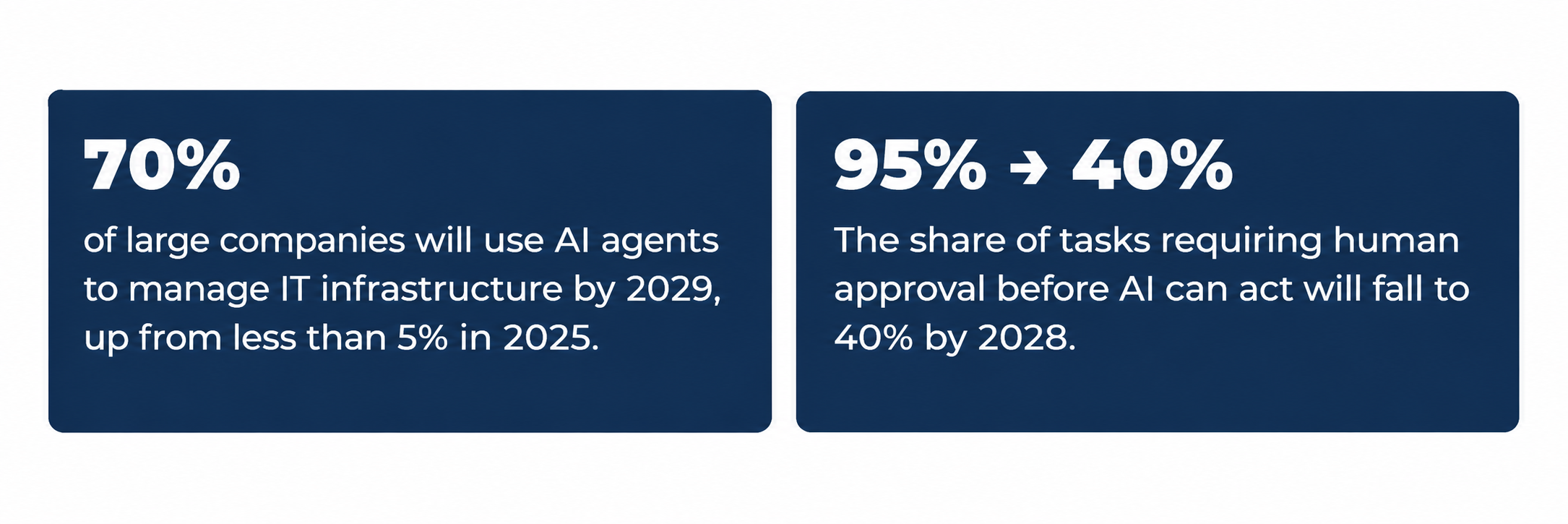
So, in a few years, the cloud will indeed become largely self‑managing. But this will happen gradually: first, AI will be entrusted with simple tasks, then increasingly complex ones.
Will AI replace DevOps engineers?
No, but the work will change. The engineer will do less manual troubleshooting and more configuring AI, setting its rules, and checking what it’s doing.
The engineer becomes like a pilot: he doesn’t hold the steering wheel the entire flight, but he monitors the autopilot and takes control in a difficult situation.
How to prepare cloud infrastructure for AI
To ensure that AI is beneficial and doesn’t create problems, a company needs to prepare three things:
1
Order in the data
AI makes decisions based on monitoring data. If the data is incomplete, it will make mistakes, and very confidently at that.
2
Limited rights
The AI should have its own account with access only to what it truly needs.
3
Action log
It should be clear what the AI did, why, and how to undo it. If an action cannot be undone, the AI is not trusted with it.
It’s best to start with what already works reliably: monitoring, fault detection, expense advice. Important decisions that affect customers and the budget are best left to humans for now.
The budget is best left to humans for now.
Frequently asked questions about AI in cloud management
What is an AI agent in the cloud?
It’s a program that doesn’t just give advice – it actually performs actions in the cloud: it restarts the service, changes the server capacity, rolls back an update. It does this only within the boundaries set by the team.
Can AI already manage the cloud without humans?
Only in simple cases where the error is easy to fix. Serious failures and decisions about money are still made by humans.
How does AI help reduce cloud costs?
It identifies servers for which the company is overpaying, alerts about unusual expenses, and forecasts the bill at the end of the month.
When will the cloud become fully automated?
Gartner expects that by 2028–2029, AI will handle most of the routine infrastructure management tasks on its own. However, the cloud will not operate completely without human intervention in the coming years.
Where to start implementing AI in cloud management?
Start with order in monitoring and logs, clear rules for actions in case of failures, and clear access rights. If the data is incomplete, AI will speed up not work, but errors.