Launching your own cloud takes more than installing a hypervisor. Below we look at three approaches to building a cloud and compare VMware Cloud Foundation, Proxmox VE, OpenStack and vStack SPP from the perspective of a service provider in the UAE.
What is needed to launch a commercial cloud
A commercial cloud needs compute, storage and networking, multi-tenancy, a self-service portal, automated provisioning, billing, backup, monitoring, an API and support. When choosing a platform, the provider must evaluate the entire customer journey: from registration and server ordering to billing and recovery from failures. On top of the software, you need servers, a data center, IP addresses, internet uplinks and an operations team.
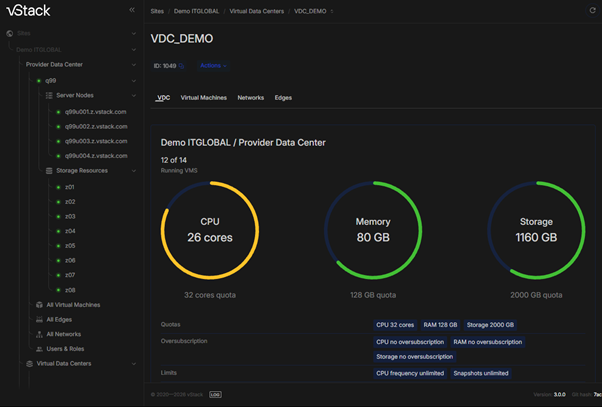
Three approaches to building your own cloud
- Assemble a stack from open-source components such as Proxmox VE or OpenStack. This gives maximum freedom of customization, but integration, updates and maintenance are on your own team.
- Use a comprehensive enterprise platform in which infrastructure components are already integrated, such as VMware Cloud Foundation.
- Choose a solution for service providers that combines virtualization, a customer portal, consumption tracking and pay-as-you-go software licensing, such as vStack SPP.
Comparison of cloud platforms: VMware, Proxmox, OpenStack, and vStack
VMware Cloud Foundation is a mature, integrated platform for private and provider clouds. For existing VMware customers, staying on it means fewer organizational changes, but the current Broadcom licensing terms and total cost of ownership need to be re-evaluated.
Proxmox VE is an open platform based on KVM and LXC with clustering, high availability, network features, API and storage options, including Ceph. For a public commercial cloud, a customer portal and billing usually have to be added separately.
OpenStack is a modular open cloud platform with extensive automation and configuration capabilities. It is suitable for large and specialized infrastructures, but requires a strong engineering team for integration and operation.
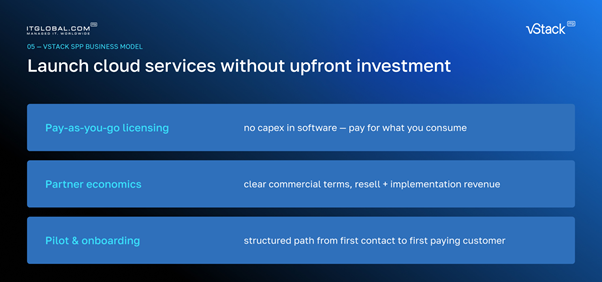
vStack SPP is a program for service providers built on vStack HCP and vStack Cloud Panel: the provider pays for the software monthly, based on actual resource consumption. The provider sells services under its own brand and manages its own tariffs and customers.
How to choose a platform for your own cloud
If compatibility with the current VMware environment is critical, start by auditing licenses and architecture. If the priority is open source and your own engineering team, consider Proxmox or OpenStack. If you need a ready-made infrastructure and customer-facing stack with pay-per-use software licensing, look at vStack SPP. Compare not only the cost of the license, but also the TCO: equipment, operation, development, support, and scaling.
vStack SPP: a platform for service providers
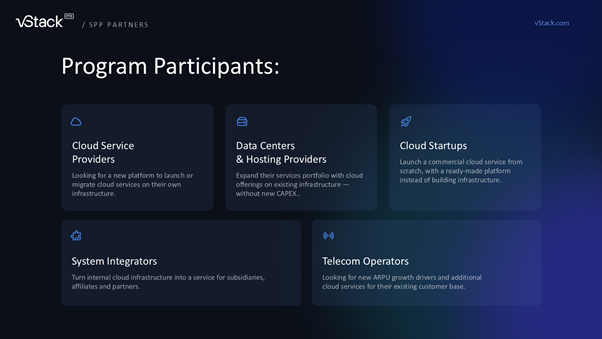
What vStack SPP consists of
vStack HCP combines software‑defined computing, storage, and networking. vStack Cloud Panel provides self‑service, resource management, tariffs, and billing. The Enterprise edition of Cloud Panel is included in the program; EnterprisePlus (+5% of consumed points) adds services such as Kubernetes, S3, DNS and CDN and lets you manage VMware environments from the same panel. VDI and Backup are available as add-ons. Thanks to adaptive vCPU quantization, CPU oversubscription can reach 900 % for suitable workloads; the actual ratio is confirmed by testing.
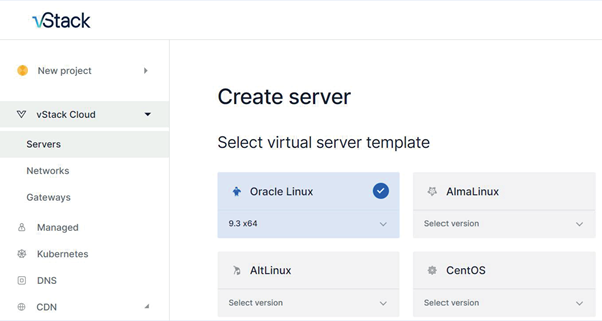
How does the pay-as-you-go payment model work?
Consumption is tracked in points based on the vCPU, vRAM, vSSD, and vHDD used; tracking is done at 10‑minute intervals. The partner selects the minimum monthly commit. According to the webinar materials, the following levels are provided: Launch (500 points), Growth (1,500), Expansion (4,500), Enterprise (22,000), Strategic (90,000+). The exact rates and rules must be confirmed with the vendor before publication.
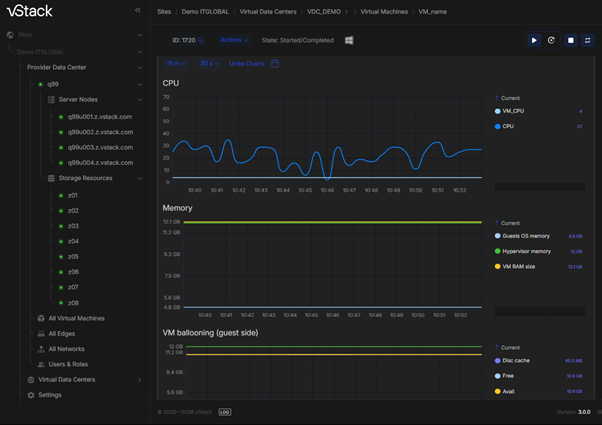
What infrastructure is needed to launch a cloud in the UAE?
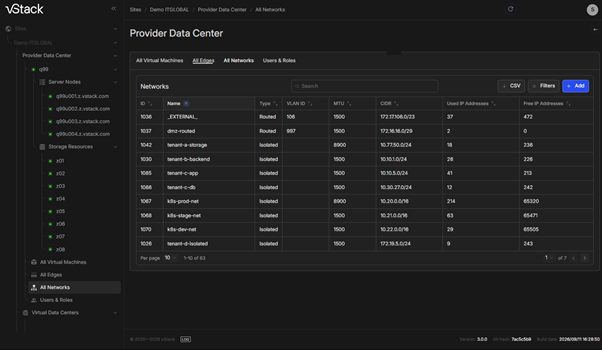
The program provides software, but the servers, network, hosting, and operations remain the provider’s responsibility. vStack recommends at least 4 server nodes, 2 BGP routers, 2 internet uplinks with BGP and a public IPv4 pool of /23 or larger. During onboarding, vStack provides an initial architecture consultation and an infrastructure readiness check; the platform itself is deployed by the provider or its integrator. For the UAE, it is important to determine in advance the data location, network connectivity, backup, administrative access model, and the requirements of specific industry clients. Hosting in the country alone does not guarantee compliance with all regulatory requirements.
How technical support is distributed in vStack SPP
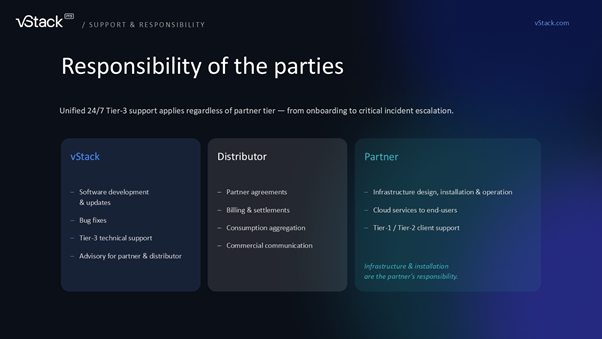
The vendor develops the software, releases updates and provides 24/7 third‑line support. The distributor (ITGLOBAL.COM in MENA) handles contracts, billing and commercial communication. The provider designs, deploys and operates the infrastructure and provides first‑ and second‑line support to its customers.
How to launch your own cloud: 6 steps
- Define the target audience and the list of services.
- Conduct an audit of servers, networks, and hosting infrastructure.
- Choose a platform and calculate the total cost of ownership.
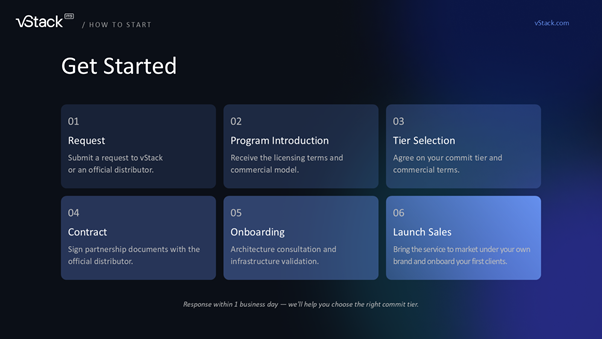
- Choose a commit tier, sign the contract with the distributor and complete onboarding.
- Deploy a test environment and test typical scenarios.
- Launch the customer portal and the first commercial services.
FAQ: Frequently asked questions about creating a cloud
1. What do you need to build your own cloud infrastructure?
To build a commercial cloud, you need server hardware, storage, networking, a virtualization platform, a self-service portal, billing, monitoring, backup, and technical support. The exact architecture depends on the services you plan to offer and the expected workload.
2. Which platform is best for building a cloud: VMware, Proxmox, OpenStack, or vStack?
The best choice depends on your infrastructure scale, technical expertise, and business requirements. VMware offers an established enterprise ecosystem, Proxmox provides open-source virtualization, OpenStack supports customizable cloud architectures, and vStack SPP delivers virtualization, a customer portal and billing as one stack with pay-as-you-go software licensing.
3. Can Proxmox be used to build a commercial cloud?
Yes. Proxmox VE can serve as the virtualization foundation for a commercial cloud. However, additional tools or integrations may be required for customer self-service, billing, and automated service provisioning.
4. How much does it cost to build your own cloud?
The total cost depends on server hardware, data center hosting, networking, software licensing, integration, maintenance, and technical support. Providers should calculate the total cost of ownership (TCO), including both initial investments and ongoing operating expenses. With vStack SPP there is no upfront license purchase: the software is paid monthly based on actual consumption.
5. Can I launch cloud services under my own brand?
Yes. In vStack SPP the provider sells services under its own brand: vStack Cloud Panel can be customized to the provider’s corporate style and already includes customer management, billing and service automation. With other platforms, these tools may have to be added separately.
6. Do I need my own data center to launch a cloud in the UAE?
No. You can deploy cloud infrastructure using your own hardware hosted in a colocation facility or an existing data center. The infrastructure must meet the platform’s technical requirements and applicable data protection, security, and regulatory obligations.
Conclusion
The choice of a platform for your own cloud should take into account the architecture, customer experience, and operational economics. VMware Cloud Foundation, Proxmox, and OpenStack address these challenges in different ways; vStack SPP offers a ready‑made stack and a consumption‑based software payment model. ITGLOBAL.COM, as the official distributor of vStack in MENA, helps to assess the architecture, select the program terms, and prepare a pilot.
Discuss your cloud architecture with ITGLOBAL.COM