vStack SPP: How to build a profitable cloud business with pay-as-you-go licensing
Launching a cloud business no longer necessarily requires large initial investments in software. Modern virtualization platforms and partnership models allow cloud providers to deploy infrastructure, launch their own services, and scale the business as the customer base grows.
This issue is particularly relevant for cloud providers and system integrators in the UAE, Saudi Arabia, and other MENA countries, where demand for local cloud services and infrastructure with controlled data placement is growing.
In this article, we will look at what is needed to launch your own cloud, what technological approaches are available on the market, and how the vStack Service Provider Program (SPP) allows you to start providing cloud services without the initial costs of purchasing software licenses.
What you need to launch your own cloud business
A cloud provider sells infrastructure as a service: customers rent virtual compute, storage and network resources on demand and pay only for what they actually use.
Unlike traditional hosting, a modern cloud platform must provide automatic resource allocation, scaling, centralized management, and the ability to independently order services.
Several key components are required to get started.
1. Server and network infrastructure
The physical foundation of the cloud consists of servers and network equipment. In a hyperconverged architecture such as vStack, there is no separate storage system: data is stored on the disks installed in each server.
The provider can use its own equipment or host it in a commercial data center.
When selecting infrastructure, it is necessary to take into account processor performance, RAM capacity, disk subsystem speed, fault tolerance, and scalability.
It is also important to assess the costs of hosting, electricity, network connectivity, and equipment operation.
2. Virtualization platform
Virtualization allows you to share physical computing resources among clients’ virtual machines.
The choice of platform affects the density of virtual machine placement, performance, service availability, and operating costs.
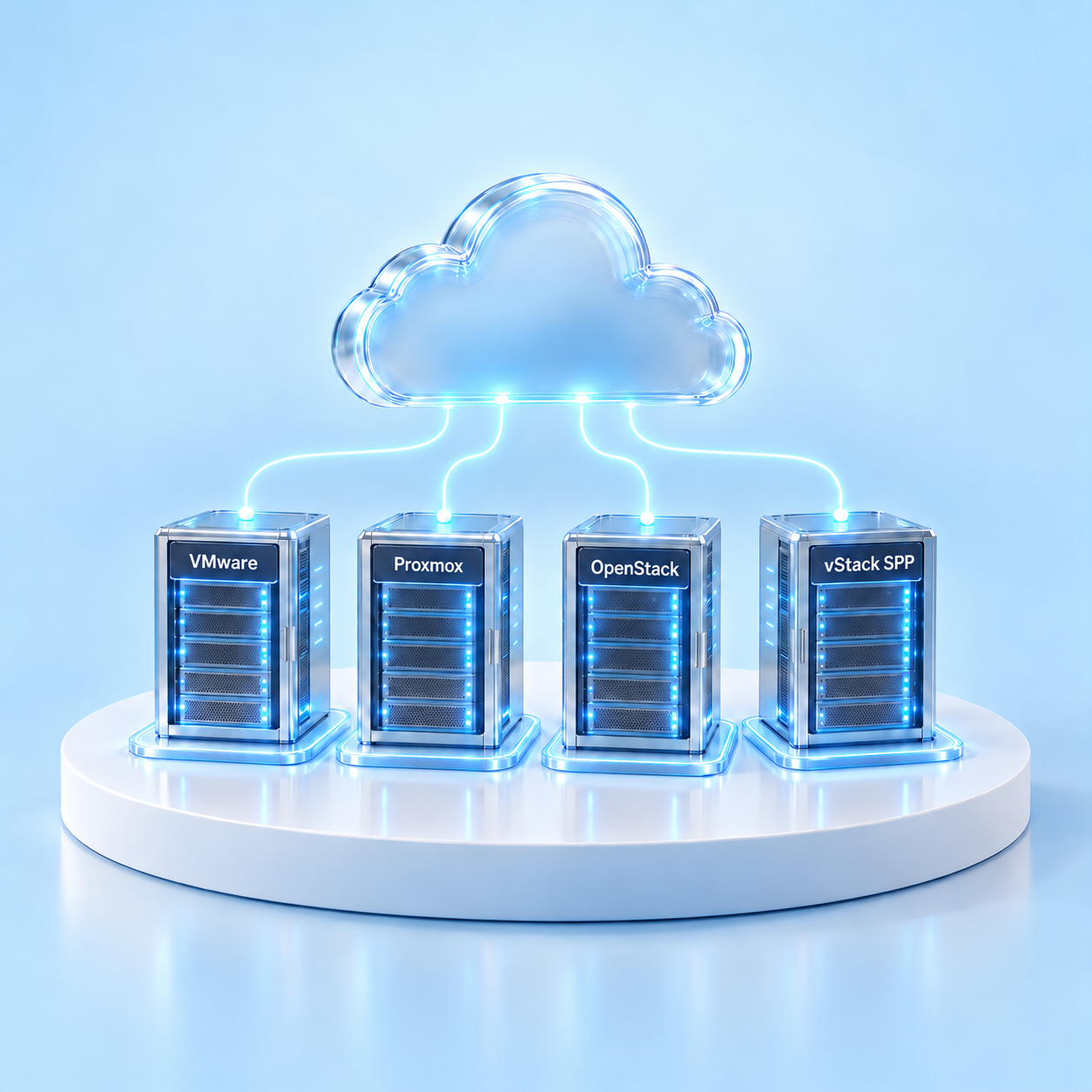
There are commercial and open‑source solutions on the market, including VMware, Proxmox, OpenStack, and vStack.
3. Self-service portal
A provider’s customers expect to be able to order a virtual server on their own, select an operating system, configure disks and networks, and then manage resources via a web interface or API.
Without a self-service portal, many operations have to be performed manually, which increases the engineering workload and lengthens time-to-market (TTM) for new services and customer requests.
4. Billing and consumption tracking
The provider needs to track vCPU, vRAM and vStorage consumption, calculate the cost of services, and issue invoices.
When developing a automation of billing, transparency of calculations, and the ability to manage multiple clients in a single system are especially important.
5. Technical support and security
The cloud infrastructure must provide access management, monitoring, backup, and disaster recovery.
Responsibilities are clearly split. The provider supplies the infrastructure and hardware, deploys and operates the platform (on its own or with an integration partner) and provides first- and second-line support to its customers. ITGLOBAL.COM, as the official distributor, handles the contract and billing. vStack is responsible for the software platform, regular updates, training, architecture consulting and 24/7 third-line support.
text_with_btn btn="Сontact us" id="50"vStack Service Provider Program /text_with_btn
What platforms can be used to launch a cloud?
The choice of a technological platform affects not only the cost of launch but also the economics of further scaling.
Let’s look at three common approaches.
OpenStack: flexibility and extensive customization options
OpenStack is an open cloud platform that allows you to create private and public clouds.
It provides components for managing computing, networks, storage, and user identification.
The main advantage of OpenStack is the flexibility of its architecture and extensive customization options.
However, turning OpenStack into a commercial cloud usually means maintaining an in-house development team: instead of licenses, the provider pays for integration, custom development and ongoing updates. There is no guarantee that the result will match the quality of mature platforms such as VMware, Nutanix or vStack, and building the stack in house can leave the provider several years behind competitors.
Proxmox: open-source-based virtualization
Proxmox VE provides tools for managing virtual machines, containers, and clusters.
The platform can serve as the foundation for cloud services, especially if the provider has a team capable of independently integrating the necessary tools.
For a commercial cloud, it will be necessary to evaluate the architecture of client self‑service, pricing and billing, as well as the automation of the service lifecycle.
vStack: integrated infrastructure for cloud business
vStack combines software‑defined computing, storage, and networking in a single platform.
Combined with vStack Cloud Panel, the provider gets an infrastructure layer and tools to deliver cloud services to customers.
The platform allows managing virtual machines, customer resources, consumption, and billing.
For cloud providers, the vStack SPP program is available, with monthly software payment.
Comparison of approaches to building a commercial cloud
Criteria
OpenStack
Proxmox VE
vStack SPP (vStack HCP + Cloud Panel)
Platform Type
Modular cloud infrastructure platform
Server virtualization and infrastructure management platform
Integrated HCI platform with a cloud service management ecosystem
Software Licensing Model
Open source; optional commercial support
Open source; optional paid subscriptions
Commercial, consumption-based licensing through the SPP program
Upfront Software Licensing Costs
No mandatory license purchase
No mandatory license purchase
No perpetual license purchase required; program commitments may apply
Infrastructure Architecture
Modular compute, storage, and networking services
KVM/LXC virtualization with integrated storage and networking capabilities
Integrated software-defined compute, storage, and networking (SDC, SDS, SDN)
Self-Service Portal
Horizon dashboard; customization may be required
Built-in administration interface; customer-facing portal requires additional solutions
vStack Cloud Panel with customer self-service capabilities
Billing and Monetization
Metering and rating components available; billing integration required
Requires third-party or custom billing integration
Billing and service management tools available through Cloud Panel
Multi-Tenancy
Native project-based isolation and role management
Role-based access control; additional integration may be needed for commercial multi-tenancy
Multi-tenant cloud management capabilities
API and Automation
Extensive APIs and orchestration tools
REST API, CLI, and third-party automation
APIs and automation capabilities within the vStack ecosystem
High Availability
Supported through configurable infrastructure services
Built-in clustering and HA management
HA capabilities within vStack HCP
Deployment Complexity
Requires expertise in multiple OpenStack services
Relatively straightforward for virtualization; additional work for commercial cloud services
Integrated software stack; infrastructure preparation, deployment, and configuration still required
Scalability
Designed for large-scale, distributed cloud environments
Cluster-based scaling; architecture depends on workload and infrastructure
Cluster-based scaling within the supported vStack architecture
Technical Support
Community or commercial support providers
Community and subscription-based commercial support
24/7 vendor-provided Level 3 support under SPP
Hardware Requirements
Depends on architecture and deployment size
Broad hardware compatibility; requirements depend on configuration
Partner-provided infrastructure meeting vStack compatibility and program requirements
Primary Use Case
Private and public clouds requiring extensive customization
Enterprise virtualization, hosting, and cloud infrastructure
Commercial cloud services for providers seeking an integrated platform and service management ecosystem
Open source solutions can be attractive from a licensing perspective, but their operation requires company’sown engineering resources.
A commercial integrated platform allows you to reduce the amount of independent development and integration, but it requires regular payments to the vendor.
Therefore, the choice should be made based on the total cost of ownership and the planned business model.
What is vStack Service Provider Program*
vStack Service Provider Program (SPP) is a partner program for cloud providers, data centers, hosting companies, system integrators, and MSPs.
It enables providers to launch their own cloud on vStack under a pay-as-you-go model, where software costs scale with resource usage.
Instead of purchasing perpetual licenses at the start, the partner chooses the level of commitment and pays for consumption on a monthly basis.
This allows to switch from capital expenditures on licenses (CAPEX) to operating expenses (OPEX).
Nota bene: SPP covers software only. Equipment, data center hosting, network and staff costs remain with the provider.
Who is vStack SPP suitable for?
The program is aimed at several categories of companies:
Cloud providers who want to expand their existing services or replace their virtualization platform.
Data centers and hosting providers planning to monetize their own computing resources.
System integrators and MSPs who want to supplement their project-based business with recurring revenue from cloud services.
Telecom operators developing their own cloud products for corporate customers.
New cloud companies that want to launch services without large initial costs for software licenses.
How payment works in vStack SPP
Software consumption in SPP is measured in points.
The number of points is calculated based on the resources allocated to virtual machines: processors, RAM, and disk space.
Points = vCPU × CPU frequency (GHz) × 0.5 + RAM (GB) × 0.5 + SSD (GB) × 0.05 + HDD (GB) × 0.01
vCPU and vRAM are counted only for powered-on VMs, disk space for all provisioned VMs; consumption is tracked every 10 minutes and totaled at the end of the month. Cloud Panel Enterprise is included at no extra cost. Add-ons are billed on top: vStack VDI +5 points per desktop VM, vStack Backup 0.02 points per GB of protected data, Cloud Panel EnterprisePlus 5% of total points (minimum 500 points per month).
For example, a virtual server configuration may include:
2 vCPUs with a frequency of 3 GHz;
10 GB of RAM;
150 GB of SSD.
According to the formula, this configuration corresponds to 15.5 points per month.
Partner Program Tiers
vStack SPP offers five partnership tiers. 24/7 third-line support is the same at every tier; from Growth upward partners get co-marketing, and Enterprise and Strategic partners also get a dedicated manager and a say in the product roadmap.
Tier
Monthly Commitment, Points
Starting Price, USD/month
Launch
500
$652
Growth
1,500
$1,761
Expansion
4,500
$4,402
Enterprise
22,000
$17,218
Strategic
90,000+
$58,697
Commit is the minimum monthly consumption volume that the partner undertakes to pay. The commit level is set per calendar month and can be changed by the last business day of the previous month, or fixed for 12 months under an Annual Commitment.
If the actual consumption exceeds the selected level, additional points are charged at the rate corresponding to the level.
The higher the tier, the lower the price per point: from $1.3 at Launch to $0.65 at Strategic.
How to start with the minimum level
The Launch level provides 500 points per month and is available for up to three consecutive months. It is intended for a pilot launch, infrastructure testing, and attracting the first customers. After the start‑up period ends, the provider either moves to Growth (1,500 points) or a higher level, or leaves the program.
vStack Cloud Panel: a self‑service portal for customers
One of the most challenging tasks when launching a cloud is creating a convenient system for ordering and managing services. Customers expect to be able to obtain resources on their own, without having to contact technical support for every operation.
vStack Cloud Panel solves this problem through a unified cloud service management panel.
Opportunities for customers
Through the self‑service portal, users can:
Create virtual servers.
Select an operating system and configuration.
Manage virtual disks
Configure virtual networks.
Select an available hosting location.
Work with the infrastructure via API.
View service consumption and costs.
Opportunities for the provider
The provider receives tools for managing client services, pricing, billing, and resource consumption.
An additional advantage is the ability to combine vStack resources and existing VMware capacities in a single panel. Thus, the provider can gradually switch to a new platform without abandoning the existing client infrastructure.
How to increase the profitability of a cloud business
The economy of a cloud provider depends on several factors: the cost of equipment, licenses, placement, operation, and infrastructure load.
The key lever is how efficiently physical servers are used: the more virtual machines a host can run without degrading performance, the lower the hardware and software cost per customer. This depends directly on the virtualization platform and, in particular, on CPU oversubscription.
CPU oversubscription
vStack supports adaptive vCPU quantization with the ability to oversubscribe processor resources by up to 900%.
This allows more virtual machines to be hosted on existing hardware, provided that the actual load profile allows for such resource allocation.
For the provider, increased hosting density may mean reduced hardware costs per virtual machine.
However, the permissible level of oversubscription must be determined based on testing real workloads.
Service automation
The self-service portal reduces the number of manual operations related to server creation, configuration changes, and service management. This enables serving a growing customer base without a proportional increase in team size.
Payment for software as it grows
The SPP model allows you to align software costs with the scale of your cloud business.
Instead of purchasing licenses for future infrastructure, the provider selects the level of commitment and increases it as consumption grows. This is especially relevant for companies that are launching new cloud products and do not yet have a stable forecast of customer demand.
Practical example: Serverspace experience
The international cloud provider Serverspace has been using the vStack platform since 2019. The company switched to a new infrastructure after assessing the cost of VMware licensing and testing alternative solutions.
One of the key requirements was the ability to efficiently use CPU resources while maintaining the performance of virtual machines. The cost of a similar virtual machine on vStack was about half the cost on VMware. In addition, the automation and integrated architecture of the platform made it possible to simplify infrastructure operation.
How to launch a cloud using the vStack SPP program
Launching your own cloud can be divided into five main stages.
Step 1. Define the business model
At the first stage, you need to select the target audience and the list of services.
These could be virtual servers, private clouds, backup, VDI, or other infrastructure services.
It is also important to define the pricing model, the expected equipment load, and the customers’ requirements for service availability.
Step 2. Assess the infrastructure
The provider prepares the server and network infrastructure. vStack recommends at least four server nodes, two BGP routers, two internet uplinks with BGP and a public IPv4 pool of /23 or larger.
If the infrastructure already exists, an audit of its compatibility and available resources is carried out.
Step 3. Select the SPP level
Based on the planned consumption, the appropriate program level is determined.
For a pilot launch, partners can start with the Launch tier, which requires a minimum monthly commitment of 500 points and is available for up to three months.
Step 4. Deploy the platform
The provider deploys vStack HCP and Cloud Panel on its own or with an integration partner; installation services are not part of SPP. vStack provides architecture consulting and validates infrastructure readiness.
vStack trains the provider’s engineers, and the platform is tested before going live.
Step 5. Launch commercial services
After checking the infrastructure, the provider can start providing services to the first customers.
As the customer base grows and resource consumption increases, the partner moves to a higher SPP level.
Why local cloud infrastructure matters in the MENA region
For companies in the UAE, Saudi Arabia, and other countries in the region, data hosting, infrastructure manageability, and the availability of local technical support are becoming increasingly important.
A proprietary cloud platform allows the provider to independently determine the location of equipment, the architecture of services, and the terms of customer service. This creates opportunities to offer local cloud services to organizations that have specific requirements for data storage and infrastructure control.
However, compliance with regulatory requirements depends not only on the geographical location of the servers, but also on the specific architecture, security processes, and operating conditions.
text_with_btn btn="Сontact us" id="50"vStack Service Provider Program /text_with_btn
FAQ
Is it possible to launch a cloud without purchasing software licenses?
Yes. vStack SPP provides for monthly payment for software without the need to purchase perpetual licenses at the start. However, it is necessary to provide server and network infrastructure.
Do you need to build a data center from scratch?
No. The provider can use existing equipment and hosting in a commercial data center, provided that the infrastructure meets vStack requirements.
What are points in vStack SPP?
Points are accounting units for resource consumption. Their number depends on the configuration of virtual machines and is used to calculate the monthly fee.
Can existing VMware resources be used?
Yes. vStack Cloud Panel allows you to work with vStack and VMware resources within a single panel, which can simplify a gradual transition.
Who is responsible for technical support?
vStack provides 24/7 third-line support, software updates, training and architecture consulting, and validates the infrastructure before launch. The provider (on its own or with an integration partner) deploys the platform and gives its customers first- and second-line support.
Is vStack SPP suitable for a small provider?
The program includes a Launch starter tier, but the economic feasibility must be assessed taking into account the minimum obligations, equipment, and expected customer load.
Conclusion
Launching your own cloud is not just a technological project, but also building a sustainable business model.
The provider needs to take into account the cost of infrastructure, licensing, operation, automation, and technical support.vStack Service Provider Program offers a model for launching cloud services without initial investments in software licenses, with monthly payment based on consumption and access to the vStack HCP and Cloud Panel ecosystem.
ITGLOBAL.COM is the official distributor of vStack in the MENA region. We help cloud providers, data centers, telecom operators, and system integrators assess their infrastructure, select the terms of participation in the program, and prepare for launching cloud services.
Are you planning to launch your own cloud or develop an existing cloud business? Contact ITGLOBAL.COM to learn more about vStack SPP and discuss the terms of a pilot launch.